A Wine Tasting at Little Italy’s Enoteca DiPalo

A wine tasting was the last thing on my mind when I signed up for Ahoy New York’s Food Tasting and Cultural Walking Tour of Little Italy and Chinatown a few weekends ago.

However, several hours after our tour, my friend, Joan and I were back at DiPalo’s to buy some of the cheeses we had sampled.

A woman was standing at the counter next to us as Joan placed her order. Hearing the type of cheeses we were getting, she told us we needed to get a bottle of wine next door at Enoteca DiPalo (DiPalo’s Wine Bar). There’s a tasting going on now, she added.

Joan and I headed next door as soon as we got our order. About a dozen people were in the narrow space, which had bottles of wines positioned at various angles against an exposed brick wall. (an enoteca is a wine library).

Wine tasting
Enoteca DiPalo

A small group of about seven stood in a loose circle towards the back of the enoteca as if they were at a private tasting. Everyone else milled around, glass in hand.

Enoteca DiPalo, DiPalo’s Selects’ latest venture, opened in 2008. While DiPalo’s Selects carries specialty foods from all of Italy’s twenty regions, Enoteca DiPalo carries wines and spirits. It also offers regular tastings to educate the community on Italian wines.

Sam DiPalo, a descendant of Savino DiPalo, the cheese maker who started DiPalo’s runs the enoteca. Sam spent several years studying Italian wines and food products at Italy’s University of Gastronomic Sciences in Pollenza.

Wine tasting Enoteca DiPalo
Tabarrini Montefalco Rosso

We tasted Tabarrini’s Montefalco Rosso and Montefalco Sagrandino Colle Grimaldesco 2009. (Sorry, I didn’t make notes but I left with a bottle of the Rosso.)

The woman who’d told us about the tasting had said Giampaolo Tabarrini, the owner of Tabarinni Winery was at the tasting. We soon spotted him. I introduced myself and asked him about his wines. He spoke proudly and passionately about his family’s wines and the olive oil they produce and insisted that we should visit the vineyard. One person at the tasting had been and said it was worth the trip. I have no doubt.

Wine tasting at Enoteca DiPalo
Joan, Giampaolo and me

The Tabarrini family has been making wines for four generations in Montefalco, Umbria. They grow Sagrantino grapes on eleven of their twenty-two acre property and began bottling their wines towards the end of the 1990s. Giampaolo, who was in the US for a series of tastings, said they also make grappa.

Enoteca DiPalo is located at 200 Grand Street, next door to DiPalo’s Specialty Foods. Call 212-680-0545 for information on their next tasting.

I looked for a recipe that could be paired with one of Tabarrini’s wines but they were all in Italian. Here’s one from DiPalo’s. Enjoy!

Spinosi Pasta with Prosciutto and Lemon


Write a review

Print

Ingredients
  1. 3 tablespoons extra virgin olive oil
  2. Generous ½ cup prosciutto that has been cut into strips 1 to 1½-inches long
  3. 3 tablespoons white wine
  4. About 5 ounces Spinosini pasta
  5. ½ to 1 cup pasta cooking liquid
  6. 1 teaspoon finely grated lemon zest
  7. 1/4 cup freshly grated Parmigiano-Reggiano cheese
  8. 1 tablespoon minced Italian parsley
  9. Additional cheese and Italian parsley leaves for garnish
Instructions
  1. Heat the oil in a deep skillet over medium heat. Meanwhile, bring a large pot of salted water to a boil. Add the prosciutto to the skillet and cook until heated through but not browned and crisp. Add the wine and keep warm.
  2. When the water boils, drop in the pasta. Cook 2 minutes. Lift out the pasta and place in the skillet with the prosciutto.
  3. Measure 1 cup pasta cooking liquid. Add ½ cup to the skillet, stir gently and cook 1 minute. Add the lemon zest, cheese and parsley. Toss gently and cook 1 minute longer. If the pasta seems dry, add more of the pasta cooking liquid and a dash of olive oil.
  4. Divide between two heated plates. Garnish each serving with additional cheese and parsley leaves.
Notes
  1. Makes 2 main dish servings or 4 appetizer servings.
InsideJourneys https://insidejourneys.com/


How to join the #FoodieTuesday linkup –

  • Add the link to your foodie post in the link tool at the bottom of this post
  • Leave a comment.
  • As a courtesy, please include a link back to this post.
  • Tweet, G+, Like, etc., using the hashtag #FoodieTuesday


[inlinkz_linkup id=374069 mode=1]

Valentine’s Day Stories About How They Met

A few days ago, my best friend mentioned that her parents met on a blind date on Valentine’s Day. There were married for forty years until death separated them.

I remember thinking what a sweet love story then immediately it occurred to me how easily we forget that our parents were once young.

I thought I had filed the story away. But as I started outlining the post I originally wanted to write, a new idea popped into my head. Why not interview my friends and relatives about how they met?

I made a list of eight couples and texted each to get their stories. Four of them agreed.

I asked each how they met, how long they’ve been together, how they knew they had found the one, their secret to keeping their love going and how they planned to spend Valentine’s Day. Here are their stories:

When Anna Met Errol

Anna and Errol met in school. Her best friend took classes with Errol and asked him to introduce her to his friend. Errol told her that he wanted to meet her friend.

Anna and Errol started dating casually, sometimes they’d double date with her friend and his. When another of Errol’s friends told him he wanted to date Anna, Errol called Anna right away and they became exclusive.

The two couples married within a week of each other. Almost forty years and two children later, Anna and Errol still hold hands together.

Asked how they plan to spend Valentine’s Day, Anna said they didn’t need a special day to remind them of their love.

A Rasta Luv

Jenniffer: I was twenty-two when Lexie and I met. I was living in the same apartment complex as a friend of his and he

Valentine's Day
Jenniffer & Lexie

would say hello whenever we saw each other.

We were finally introduced at a neighbor’s birthday party and shared a dance. Later, my neighbor invited me to attend a concert with him and his girlfriend. I told him the only way I’d go is if he found me a date, a cute guy, not one of his ugly friends.

Lexie was the date my neighbor found. He was the youngest of his friends, and he looked young even though we are only two years apart.

We didn’t date, really, as I got pregnant shortly after. Lexie is the most attentive man I’ve met. I guess that’s when I really fell in love with him. We were both working low-paying jobs, plus he was going to school but he’d give me all his money so I could take a taxi to work.

And if I took the bus to work, he’d accompany me and make sure I got there okay. He took over the cooking, he even cleaned my shoes in the mornings. He made sure I was taken care of. The boy I met thirty-three years ago turned out to be more of a man than I expected and he still makes me feel like his queen.

How do we keep our love going? Lexie, you should answer this one.

Lexie: You’ve got to love the one you’re with.

Jenniffer: And being honest with each other. I always tell him when he does something I don’t like. I’ve never tried to change him and he’s never tried to change me.

Lexie: Openness and honesty about our feelings. Valentine’s Day? We don’t set aside a day to show each other how we feel.

Jenniffer: Lexie gets up at 5:00am everyday, makes my coffee and puts it on my bedside table. Then he kisses me goodbye and leaves for work. On weekends, if I’m tired he makes our coffee which we have in bed, sometimes makes me breakfast too as after 31 years, I no longer make weekend breakfast.

Lexie: We’re each others’ Valentines.

A Facebook Match Made in Heaven

Valentine's Day
Judith and Winston

On September 24, 2010, I received a friend request from a guy on Facebook. He had the same family name as mine – I thought he might have been a relative so I checked. He wasn’t and I accepted his request.

We had a very good conversation online but I was a bit nervous that this wouldn’t be the case when we would actually meet in person.

It was absolutely extraordinary that our conversation continued seamlessly when we met for dinner a week later. Coincidentally, as well as having the same last name, his previous wife and I share the same first name. His sister and my sister share the same name as well.

We met around 7 pm and didn’t leave the restaurant until 11:30 pm. It was easy just being ourselves. We both have a strong love for reggae music and he wanted to hear the music on my iPod. This started a music sound clash with our iPods.. he would play a song and I would say I can do better than that. We went back and forth until I won. It was a blast!

I drove to work that day and turns out he was also heading back to Brooklyn to see his uncle. I offered to drop him off all the while thinking I must be insane driving this man in my car. When we got to his uncle’s house, we stayed in my car just talking and continued playing music.

I thought to myself, and he did as well, that this must be fate. Gosh, I looked at my watch and realized it was 3:30 a.m. Yes, 3:30 a.m. Work the next morning. Remember those days?

Four years later, we still remember that sound clash and still clash over music. And he’s always making me laugh. I think I fell in love with him when I saw the care he showed his uncle, who’s like a father to him, and the warmth of their relationship.

How do we keep the sparks alive? (Laughs) We argue! No, we don’t need Valentine’s Day to appreciate each other.

A Wrong Number Leads to Love

Bev: I dialed my uncle’s number and a voice I didn’t recognize answered the phone. Excuse me, I said, I think I have the wrong number.

Delroy: And I said, well you called so you can’t hang up now, you have to talk to me.

Bev: We talked for over an hour. And he started calling.

Delroy: I knew from her voice on that first call that she was the one. But two hours drive separated us so I decided to pay her a visit. I would have recognized her in a crowd.

Bev: He asked me to marry him soon after we met. I said no.

Delroy: And I kept asking.

Bev: When he asked for the millionth time on Valentine’s Day, I threw out the first date that came to mind (10/10/10). He smiled from ear to ear and kept smiling like a Cheshire cat.

Delroy (laughing): She didn’t know that the date she said was actually my birthday.

Bev: We couldn’t get that date but we were married a few days later. We’ll be together four years this year.

Delroy: And no, we don’t need a day to recognize how lucky we are to have found each other.

How did you meet your Valentine?

The Italian American Museum in Manhattan’s Little Italy

Anchoring the corner of Mulberry and Grand Streets in New York City’s Little Italy is an attractive 19-century brick building that is the home of the Italian American Museum.

The Italian American Museum in Manhattan's Little Italy
Exterior of the museum

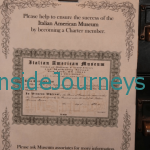
The idea for a museum to document the history of the Italian community in New York came about after the highly acclaimed exhibition, The Italians of New York: Five Centuries of Struggle and Achievement, which opened at the New York Historical Society in October 1999.

The museum founder, Dr. Joseph Scelsa received its charter in 2001. It operated initially on W44 Street before moving in 2008 to its permanent home, 155 Mulberry Street, after museum officials bought the Banca Stabile building from Dr. Jerome Stabile III. Dr. Stabile’s family started the bank in 1882.

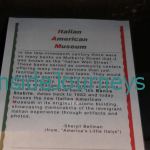
Banca Stabile, which was founded by Francesco Rosario Stabile, was a fixture in Little Italy at a time when Mulberry Street was described as the Italian Wall Street, for the number of banks that were there.

The bank became a one-stop community center, providing financial, translation, insurance, travel and money transfer services. It was a link between the immigrants in New York and their relatives and friends back home.

When Banca Stabile closed in 1932, the family kept the building, including its vault, tin ceiling, marble floor and counters, bronze grilles, and teller cages intact. They also retained items such as steam ship tickets, safe deposit boxes, bank books, passports, and deeds.

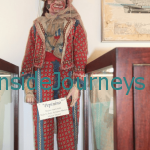
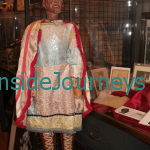
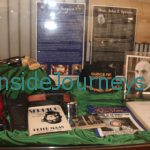
The 1,000 square foot museum is bursting at the seams with memorabilia from the bank and those that families have donated. Among the items on exhibit is the gun that retired NYPD police officer, Francesco “Frank” Serpico owned. Serpico was the cop who blew the whistle on police corruption in the 1960s and 70s.

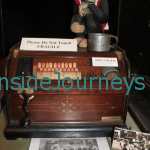
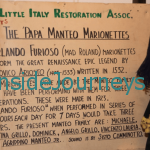
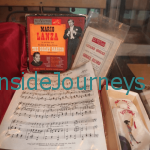
There are also several marionettes from Miguel “Papa” Manteo, photos and other information about Luigi del Bianco, chief carver at Mount Rushmore, and assorted other items that illustrate the history of Italians in New York.

The Italian American Museum, at 155 Mulberry Street, is opened on Saturdays 11:00 a.m. to 6:00 p.m., on Sundays from noon to 6:00 p.m., and by appointment during the week. For a $5.00 suggested donation, visitors to the small storefront museum are shown a short film and are able to see these memorabilia up close.


Linking to Travel Photo Thursday, which Nancie at Budget Travelers Sandbox organizes. Be sure to head over and check out more photos from locations around the world.

Food and History in New York City’s Chinatown

One of the perks of living in a city the size of New York is the diversity it offers, not only in things to do but also in culinary offerings. Food from almost every nation is represented here.

Last weekend, my friend Joan and I joined Ahoy New York for their Food Tasting and Cultural Walking Tour of Chinatown and Little Italy. We started in Little Italy and ended the tour in Chinatown. 

New York City’s Chinatown is a bustling neighborhood that is home to the largest population of Chinese outside of China – approximately 100,000. The neighborhood now occupies an area of about 2 miles stretching south roughly to Chambers Street, east to the Lower East Side, north to Little Italy and west to Broadway/Tribeca.

A Short History of Chinatown

In the mid-1800s, Chinese immigrants, men mostly, headed west to California, Gold Mountain as they called it, lured by dreams of striking it rich. Instead of gold, they found limited opportunities for work. Their dreams evaporated and with no money to return home or to send for their families their dreams they moved east.

Arriving in New York City, these former residents of Canton, settled in the area around Mott, Pell and Doyers Streets and worked as cooks and launderers, jobs usually done by women. They brought their language, culture and culinary traditions like dim sum, bite-sized foods served steamed or fried. Dim Sum has its origins in the famous Silk Road when tea houses opened to accommodate weary travelers.

Food and History in NYC's Chinatown
Liz pointing out pastries in a store on Mott Street

Our first stop was Pongrsi Thai Restaurant on Bayard Street, the oldest family-run and operated Thai restaurant in New York City. Started by Khun Pongrsi and her husband Khun Prasit Tangchakkrachai, Pongrsi has been serving authentic Thai food in the same place since 1972. It is credited with popularizing Thai food in the city.

After walking around for the better part of the morning, the chance to sit and enjoy the meal was quite welcome. We sampled Orange Chicken, Chicken Pra Ramm (peanut sauce/curry dish) and a Pad See Ew.

My favorite, the Orange Chicken, was unlike any I’ve had. The orange was subtle enough to provide a delicious balance to the chicken. By the time the plate got to me, though, only a few pieces were left – it was that good. I really love Thai food so you can bet I’ll be back to Pongsri very soon.

Leaving Pongsri, we walked through Columbus Park, and made a brief stop on Mulberry in the Five Points section of Lower Manhattan. You might remember Five Points, that notorious section of the city that was the setting for the movie, [simpleazon-link asin=”B004SIP7TE” locale=”us”]Gangs Of New York[/simpleazon-link].

Five Points got its name from the five-pointed intersection created by Orange now Baxter Street, Cross now Mosco Street, Anthony now Worth Street and Little Water Street, which or no longer exists. Today, that part of Mulberry Street is lined with funeral homes that serve the community.

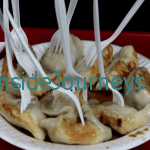
Soon we arrive at Tasty Dumpling, 54 Mulberry, for our first Chinese tasting. Can you guess what we sampled at Tasty Dumpling? Why, dumplings, of course!

Tasty Dumpling’s dumplings get rated consistently as the best dumplings in Chinatown – and at 5 for $1.25, are a tasty bargain. That probably explains why nearly all the tables in this small eatery were occupied when we arrived so we crowded into the only free space – at the left of the counter.

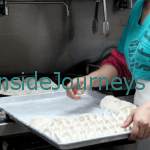
A woman was at the stove loading freshly made dumplings into a huge steamer while in the back two others were adding the filling to the dough.

Our dumplings were still warm when they arrived. Liz added a soy-white vinegar sauce and passed them around. The wrapper was nice and firm and so translucent I could see the filling, and when I took a bite, it was moist and tasty, the dipping sauce adding a nice kick.

Leaving Tasty Dumpling, we crossed over to Mott Street then to Doyers to Nom Wah Tea Parlor, our last stop on the tour. Nom Wah, the oldest dim sum restaurant in Chinatown has been around and on the same block of Doyers Street since the 1920s.

The Choy family owned the restaurant until they sold it in 1974 to Wally Tang, a longtime employee. Mr. Tang started working at Nom Wah in the 1950s when he was 16 and began managing it when he was 20.

Little has changed to the exterior of Nom Wah but Wilson Tang, the new manager and the next generation of Tangs, has upgraded the interior. Wally and his team of dim sum experts still keep an eye on things though.

It was about 1:00 pm when we arrived and diners were clustered outside in groups of twos and threes waiting for tables. Someone from the restaurant would come to the door and call the next name on the list as tables became free. Good thing Liz had placed our order ahead of time so we didn’t have to wait.

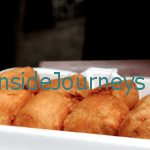
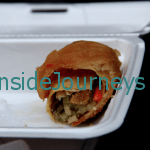
Nom Wah’s original egg rolls are round and fat. Stuffed with chicken and vegetables, they are rolled in egg crêpe then fried in homemade batter which makes them crisp and flaky. Despite being fried, they aren’t greasy. Each egg roll was cut in two and each of us got half but after all the food we’d sampled, one piece of this delicious treat was enough.

We had come to the end of our three hour tour and it was time to say goodbye to Liz, our very enthusiastic tour guide. I’m sure all of Ahoy New York’s tour guides are knowledgeable, warm and sociable but Liz makes you feel like she’s giving a tour with long time friends.

To recap, we visited Alleva Diary, DiPalo’s Fine Foods, Grand Appetito and Ferrara Bakery & Cafe in Little Italy, and Pongsri Thai Restaurant, Tasty Dumpling and Nom Wah Tea Parlor in Chinatown. We did a quick stop at the Italian American Museum, which I’ll cover in another post.

Joan and I spent the rest of the afternoon and evening in Chinatown. We had dinner at one of the cellar restaurants on Mott Street that Liz had pointed out then ended up at a wine tasting at Enoteca DiPalo’s. (More about these later.)

One thing I forgot to mention: my friend Joan has severe allergies to shellfish and Ahoy was able to arrange other dishes for her to sample on the Chinatown part of the tour.

Please note: I found this recipe for Thai Orange Chicken at Allrecipes.com.

Thai Orange Chicken


Write a review

Print

Prep Time
15 min

Cook Time
25 min

Total Time
40 min

Prep Time
15 min

Cook Time
25 min

Total Time
40 min

Ingredients
  1. 2 tablespoons olive oil
  2. 3 carrots, cut into matchsticks
  3. 1/2 teaspoon minced fresh ginger root
  4. 1 clove garlic, minced
  5. 2 tablespoons olive oil
  6. 2 skinless, boneless chicken breast halves, cut into small pieces
  7. 1/2 cup water
  8. 1/2 cup peanuts
  9. 1/3 cup orange juice
  10. 1/3 cup soy sauce
  11. 1/3 cup brown sugar
  12. 2 tablespoons ketchup
  13. 1 teaspoon crushed red pepper flakes
  14. 2 tablespoons cornstarch
Instructions
  1. Heat 2 tablespoons olive oil in a large skillet over medium heat; cook and stir carrots, ginger, and garlic until carrots are slightly softened, about 5 minutes. Transfer carrot mixture to a bowl. Add remaining 2 tablespoons olive oil to the same skillet.
  2. Cook and stir chicken in the hot olive oil until no longer pink in the center, about 10 minutes. Add carrot mixture, water, peanuts, orange juice, soy sauce, brown sugar, ketchup, and red pepper flakes to chicken; stir to combine. Cover and simmer until sugar has dissolved, about 5 minutes.
  3. Remove about 1/4 cup sauce from the skillet; whisk in cornstarch until dissolved and sauce is smooth. Pour cornstarch mixture back into chicken and sauce; cook until sauce is slightly thickened, about 5 more minutes.
InsideJourneys https://insidejourneys.com/

Disclosure: We were guests of Ahoy New York on this Chinatown and Little Italy Food Tasting and Cultural Walking Tour, but as usual, the opinions expressed here are our own. Thanks to Ray and Alana, and Liz, our very knowledgeable, very entertaining and very enthusiastic tour guide. 

Recommended Reading

[simpleazon-link asin=”0738550183″ locale=”us”]New York City’s Chinese Community (Images of America: New York)[/simpleazon-link], Josephine Tsui Yueh Lee

Can you name one popular Chinese dish that you won’t find in China?

How to join the #FoodieTuesday linkup –

  • Add the link to your foodie post in the link tool at the bottom of this post
  • Leave a comment.
  • As a courtesy, please include a link back to this post.
  • Tweet, G+, Like, etc., using the hashtag #FoodieTuesday


[inlinkz_linkup id=371596 mode=1]
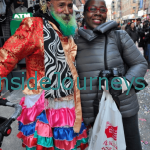
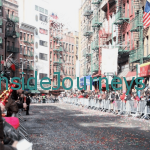
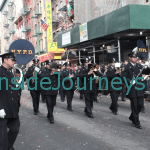
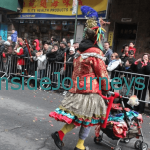
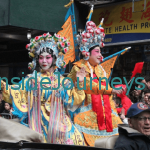
Chinese New Year Parade in New York’s Chinatown

If the temperature here in New York had remained as cold as it was during the week, I would not have gone to the Chinese New Year Parade in Chinatown on Sunday.

As it turned out, it was a welcome 53 degrees around the 1:00 p.m. start time for the parade, and a still balmy 43 degrees – warmer that it was in Denver (21) and Seattle (41) – when Super Bowl 48 kicked off in the evening. (Snow started late Sunday night and continued into Monday and we got snow overnight last night. As one of my friends said, God is a Super Bowl fan! That was her explanation for the wacky weather we’ve had.)

But before I show you those, let’s take a look at some of the ones I took the day before.

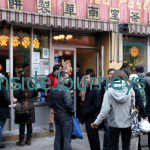
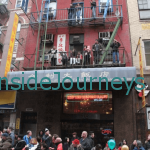
We were in Chinatown for a morning food tour  and after the tour, we followed the sounds of firecrackers to a side street off Mott. About a block long, it was so crowded with people that drivers took other streets. At one point, a police car cruised through, the officer using his loudspeaker to tell everyone that the street was not closed. Some minutes later, someone put up yellow tape, effectively creating a pedestrian-only block.

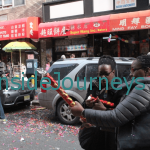
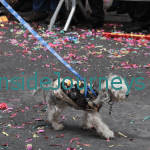
Almost everyone was setting off these long, colorful cardboard tubes that you see. They pop when you twist them and shoot confetti. It looked like too much fun not to get involved. So we bought 4 for $10 and joined in. Soon we had confetti in our hair, on our clothes. I’m still cleaning up bits of it at home.

Chinese New Year Parade Day

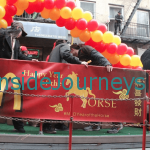
I arrived at the intersection of Canal and Mott Street around 11:30 a.m. and was surprised to see this group had already assembled there. My first thought was to watch the Parade from here but eventually it got crowded and the police officers put up barricades. You can’t move once you get behind the barricade, so I continued on Mott and looked for a spot that had fewer people. It was also near to one of the restaurants I wanted to try.

Chinese New Year Parade in New York's Chinatown
Assembling before the Parade

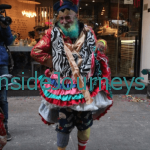
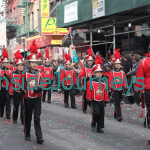
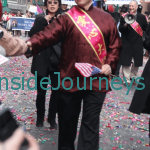
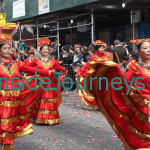
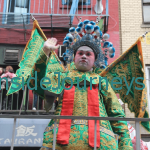
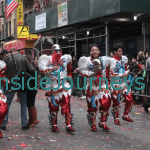
There were still lots of empty places at that end of Mott to watch the Parade after I had lunch. My timing was perfect – the 15th Chinatown New Year Parade started about ten minutes after I found my spot. I took a lot of photos – over 200 – and it was really difficult to decide which ones to use for this post. Hope you like the ones I selected.

Everyone loves a parade…especially politicians.


Enter the dragon.


The Year of the Horse began on January 31 and will end on February 18, 2015. It is thought to bring prosperity and wealth. People who are born in 1906, 1918, 1930, 1942, 1954, 1966, 1978, 1990, 2002 and 2014 are born in the Year of the Horse.


Linking to Travel Photo Thursday, which is organized by Nancie at Budget Travelers Sandbox. Be sure to head over and check out more photos from locations around the world.

Food and History in New York’s Little Italy

I’ve been to Little Italy and Chinatown many times to eat and to shop but never thought of doing a food tour. That is, until this past Saturday when I joined six other women for Ahoy New York’s Chinatown and Little Italy Food Tasting and Cultural Walking Tour.

It was the perfect day to be outside. The temperature that had stayed stuck in the 20s during the early part of the week had moved a full 20 degrees more – almost a heat wave. My friend, Joan, and I met Liz, our guide at the address Ahoy gave us. Liz was all smiles and greeted us as if we were old friends. We chatted for a while and as soon as the others arrived, we were off to Little Italy, the first leg of our tour.

Food and History in Little Italy
Welcome to Little Italy

Little Italy, which once spread from Canal Street north to Houston Street, is the area where early immigrants from Italy made their first homes after coming through Ellis Island. At its peak, in the early 1900s, New York’s Italian population numbered about 390,000. Approximately 10,000 lived in Little Italy.

As newcomers in a strange land, they found comfort with others from the regions they’d left, others to who they were bound by dialect, culture and food. So you’d find former residents of Calabria on Mott Street, Silicians on Elizabeth Street and Neapolitans on Mulberry Street.

Food and History in Little Italy
Our group in the courtyard of the Church of the Most Precious Blood

Life in the US wasn’t easy. They crowded into tenements and cold-water flats, did menial jobs to support their families here and back home. And as their economic situation improved, they spread out to Staten Island, Brooklyn, Queens, the Bronx, New Jersey and Long Island.

Through gentrification, the movement outward of Italians, and the growing population of nearby Chinatown, Little Italy has shrunk. Today, the community takes up only four blocks on Mulberry between Broome and Canal Streets. But what it’s lost in geographic size, it’s more than made up for in heart and soul and good food in over 40 restaurants, cafes and bakeries, that draw thousands of New Yorkers and visitors each year.

In 2010, the National Park Service designated Little Italy and Chinatown a Historic District.

Little Italy Food Tasting and Cultural Walking Tour

Leaving our meeting place on Canal Street, we walked northeast on Mulberry Street, stopping briefly at the historic Most Precious Blood Church, a Roman Catholic Church that has served the community since its founding in 1891.  

Continuing on Mulberry, we made our first stop Alleva Dairy at 188 Grand Street. Alleva was established in 1892, by Pina Alleva, the matriarch of the family, who came to the US from Benevento. Alleva, the oldest Italian cheese store in America and is still run by the family.

Food and History in Little Italy
Alleva

Alleva does not use artificial flavors. They sell cheese as well as pasta, salami, sausages and imported olive oil, among other items.

Food and History in Little Italy
Prosciutto and Mozzarella

At Alleva, we sampled prosciutto and homemade mozzarella. I’ve had mozzarella on pizza but never by itself – its blandness doesn’t make it very appetizing to me. But I was curious to see how the homemade tasted — not that I expected one tasting to change my mind — but I’ve always preferred to start with the best.

Food and History in Little Italy
Di Palo’s

Continuing on Grand, our next stop was at Di Palo’s Fine Foods. Another family-run establishment, Di Palo’s has been serving Little Italy since 1910, when Savino Di Palo, a cheese maker, opened his latteria or dairy store.

Now run by the fourth generation, Di Palo’s sells select traditional products that are imported directly from Italy. They carry foods from every region. The staff is friendly and knowledgeable, the counters were designed low enough to give customers the feeling they’re in someone’s kitchen. Di Palo’s believes in educating their customers and has a chef in house and an enoteca (wine shop) next door. (More about this later.)

There were only a few people when we arrived but Liz, our tour guide, said it’s quite different later in the day and on Sundays. (Joan and I saw that when we returned around 5 p.m. to buy cheese. The store was crowded but it took about 20 minutes for us to fill our order.)

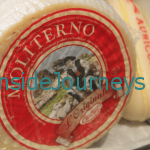
At Di Palo’s, we sampled two different cheeses – a piave and a moliterno (pecorino). Piave is made from cow’s milk while the moliterno is made from sheep’s milk with a small percentage of goat’s milk. To keep its moisture and flavor, olive oil is rubbed into the moliterno during the aging process.

Light yellow in color, almost like butter, the piave is hard and has a mild taste. It would be perfect with grapes and other fruits, or on its own. In contrast, the moliterno was sharp and slightly salty. It definitely woke up my tastebuds. I would use it in salads or add it to a cheese platter.

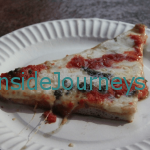
Leaving Di Palo’s, we crossed the street to Grand Appetito for a slice of pizza. As you can imagine, this isn’t any old pizza. Angelo, Grand Appetito’s owner, believes in making pizza the old-fashioned way and uses only homemade mozzarella in his pies.

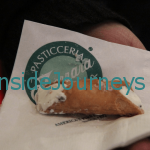
We made our final stop for cannoli next door at Ferrara Bakery & Café, another family run business. Ferrara has been a fixture in Little Italy since 1892 and is famous for its cannolis and Italian pastries. My cannolo was sweet and creamy. Thankfully, we were on a schedule as I could have easily gotten lost feeding my sweet tooth at Ferrara’s.

After we completed the Little Italy segment of the tour, we crossed Canal for the second half of our tour in Chinatown.

Thanks to Ahoy New York for hosting us on their Chinatown and Little Italy Food Tasting and Cultural Walking Tour, and to Liz, our very knowledgeable, very entertaining and very enthusiastic tour guide.

Liz’s Book Recommendations

[simpleazon-image align=”left” asin=”0547744943″ locale=”us” height=”110″ src=”http://ecx.images-amazon.com/images/I/51iB21JPGzL._SL110_.jpg” width=”73″]Elizabeth Street, Laurie Fabiano


[simpleazon-image align=”left” asin=”0061288519″ locale=”us” height=”110″ src=”http://ecx.images-amazon.com/images/I/51z6LYIXhSL._SL110_.jpg” width=”73″]97 Orchard Street: An Edible History of Five Immigrant Families in One New York Tenement, Jane Ziegelman


How to join the #FoodieTuesday linkup –

  • Add the link to your foodie post in the link tool at the bottom of this post
  • Leave a comment.
  • As a courtesy, please include a link back to this post.
  • Tweet, G+, Like, etc., using the hashtag #FoodieTuesday

[inlinkz_linkup id=369020 mode=1 pageSize=300]

Super Bowl Boulevard is Open

If you know New York City, you know it’s got energy and excitement all its own but with the first Super Bowl in 42 years just four days away, the buzz is even more palpable. 

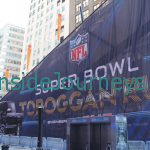
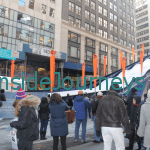
Broadway between 34th and 47th Streets has been transformed into a pedestrian-only thoroughfare, called Super Bowl Boulevard, where football fans who have registered, can join in the revelry which started on Wednesday.

Even though I love the parties and the commercials, I never got into American football. Learning 30-odd years ago that the football that I grew up watching in Jamaica, and playing recreationally, wasn’t the same game that’s played here made me lose interest, I think. But walking through midtown on Monday, I couldn’t dismiss the excitement in the air over the match up between two stellar teams – the Seattle Seahawks and the Denver Broncos.

So despite the cold – it was in the 20s when I left yesterday morning and with the wind chill, it felt like 8 F — I grabbed my camera, bundled up as warmly as I could and headed out to Super Bowl Boulevard.

Though it wasn’t as windy as the previous day, I knew I should limit the time I left my fingers exposed so I switched the settings on my I set my camera to automatic and started snapping quickly, trying to get in as many shots as possible. I did fine for about 10 minutes, then the cold began to chill my fingers. Note to self: need to find thin and warm gloves.

At least I could move around or go into a store to get warm up. The crew that will be managing the Boulevard will be out in the open working 12-hour days. And the people who have to stand on line to register for all-access passes can’t move around or they’d lose their place. Still, it’s no fun when your fingers are so cold you can’t sense the shutter button. 

Are you ready for some football? 

Linking to Travel Photo Thursday, which is organized by Nancie at Budget Travelers Sandbox. Be sure to head over and check out more photos from locations around the world.

Super Snacks for this Sunday’s Super Bowl

If you’re in Manhattan this week, it’s difficult to ignore the increased activity in the city as New York and New Jersey get ready to host this year’s Super Bowl with the Denver Broncos and the Seattle Seahawks at MetLife Stadium in East Rutherford, New Jersey.

The Super Bowl was not on my mind as I walked through midtown yesterday but as I got to Bryant Park, I noticed trailers and work crews. At first, I thought they were preparing to shoot a movie or television show. But as I approached Broadway, I knew it had to be the Super Bowl.

Work crews had erected barricades which blocked off Broadway from 34th to 47th Streets, creating a pedestrian-only thoroughfare that I found out later goes by the temporary name, Super Bowl Boulevard. They had also started installing giant television screens and stages for performances.

The whipping up of the winds reminded me of the prediction that the temperature would dropped significantly from the morning’s balmy 40 degrees to the 20s. As I hurried to the subway, I thought about the weekend’s forecast and the thousands of football fans who’d be watching the game from these giant screens on Super Bowl Boulevard, those who’d be sitting in the uncovered stadium and the players who’d be playing outside.

If the predictions hold, it’ll be a cold weekend — the first time the Super Bowl will be played outdoors in a cold environment. So as I settled into my seat for the ride home, I began thinking about the kinds of snacks I’d prepare if I had to host a Super Bowl party.

Whether we get the snow and 20 degree temperatures is anyone’s guess. Either way, it’s still winter so my super snacks will be warming, filling, tasty and most importantly, can be all prepared ahead of time.

I’d keep a pot of chicken soup on a low flame and ladle it out as guests arrive. Then I’d have jerk chicken wings, ackee and saltfish bruschetta, Festival, spinach or vegetable cocktail patties, stewed peas (meatless), roast pork, coleslaw, and macaroni and cheese. For dessert, I’d make a fruit cake and ambrosia, and have lots of Red Stripe beer and rum punch on hand.

Jerk Chicken Wings


Write a review

Print

Ingredients
  1. 3 pounds chicken wings
  2. ½ cup Jerk Rub
  3. 1 onion, finely chopped
  4. 1 Scotch bonnet pepper, minced (optional)
  5. 1 spring fresh thyme, minced
  6. 2 scallions, finely chopped
Instructions
  1. Mix together the jerk rub, onion, pepper, thyme and scallions. Rub mixture thoroughly into the wings. Cover and refrigerate for 4-6 hours or overnight.
  2. Heat oven to 350°F, cook covered for 1 hour or until done. Remove the cover and let wings bake another 15-20 minutes until it turns dark in color.
  3. If you’re using a gas grill, preheat it to 225° to 250°F. Place the wings on the grill and cook, covered, for about 1 hours, turning every 5 minutes. Wings will take on a very dark color and the juices run clear when they are pierced.
  4. Serve with Festival and coleslaw.
InsideJourneys https://insidejourneys.com/

What snacks are you making for Sunday’s Super Bowl?

How to join the #FoodieTuesday linkup –

  • Add the link to your foodie post in the link tool at the bottom of this post
  • Leave a comment.
  • As a courtesy, please include a link back to this post.
  • Tweet, G+, Like, etc., using the hashtag #FoodieTuesday

[inlinkz_linkup id=366004 mode=1 pageSize=300]

Ugli, the Fruit

With its lumpy peel and lopsided shape, the UGLI® is the ugly duckling of the citrus family. But don’t let appearances sway you. The ugli proves the adage: beauty is skin deep, ugly goes to the bone, or in this case, the core.

Peel back its yellow-green skin, which is soft and surprisingly easy to remove, and the ugli reveals several light pink pegs bursting with an unusual amount of sweet and slightly tangy juice and few, sometimes no seeds.

Ugli Fruit
Ugli

The ugli is a cross between the Seville orange (which gives it its dimpled skin), the grapefruit (from which it derives its color), and the tangerine (from which it gets its loose skin), was developed by Jamaican agronomists.

Called ugli because of its appearance, the fruit was found growing wild near Browns Town in the parish of St. Ann about 90 years ago. A commercial variety was later developed. Ugli is registered under trademark and is exported to the US, UK, Canada, Scandinavia and some Eastern European countries.

The ugli has 45 calories, 2 grams of dietary fiber and 70% of the recommended daily allowance of vitamin C.  It can last up to 6 days unrefrigerated, and a week or more in the refrigerator.

If you’re in Jamaica during the citrus season (November/December to April/May), you should ask to try the ugli. It’s not as common as its forebears and because of that, is typically more expensive.

On the other hand, you might be lucky to meet someone who’s got a tree or two in their backyard. I hope you get to try it.

Ugli is perfect for sweet and savory recipes. I’ve used it mainly in juices and fruit salads but I’d love to try this Ugli Duckling from ugli.com

UGLI® Duckling


Write a review

Print

Ingredients
  1. 4 - 4½ lb (1.8 - 2 kg) plump duck, fresh or thawed frozen
  2. A little salt
  3. 1 medium sized UGLI® tangelo
  4. 4 tbsp Cointreau
To garnish
  1. Small bunch watercress, washed and drained
  2. 6 - 8 potatoes
Instructions
  1. Prick the duck all over with a fork. Rub a little salt into the duck skin and place on a trivet in a roasting pan.
  2. Roast for 1½ - 1¾ hours at 375 deg F (180 deg C) without basting.
  3. Meanwhile cut the skin including the pith off the UGLI® tangelo.
  4. Carefully slice the fruit into slices and cut in half. Gently poach the fruit in Cointreau for 4-5 minutes then pour the remaining juice over the duck when cooked on the serving plate.
  5. Garnish with fruit slices, watercress and Duchess or mashed potatoes.
InsideJourneys https://insidejourneys.com/

How to join the #FoodieTuesday linkup –

  • Add the link to your foodie post in the link tool at the bottom of this post
  • Leave a comment.
  • As a courtesy, please include a link back to this post.
  • Tweet, G+, Like, etc., using the hashtag #FoodieTuesday

[inlinkz_linkup id=363337]

Gingerbread Houses, Jamaica

With so many Jamaican homeowners embracing modern design, I’m always pleasantly surprised when I see gingerbread houses, especially ones that seem relatively new. Gingerbread houses probably came to Jamaica around the turn of the century.

My friend and I spotted this gingerbread house in Trelawny. We had spotted some lovely green bananas and stopped to buy a bunch. The house was directly across the street from the farmer and the minute I saw it – it was such a delight to see – I forgot why we’d stopped in the first place.

After he cut the bunch we decided on, I asked the farmer who asked the resident who graciously allowed me to take a photo. Unfortunately, he wasn’t the owner and couldn’t tell me much about the house, like the year it was built, for example. We guessed it to be about 50 years old.

Gingerbread houses
Trelawny

Another day, another drive, this time in Westmoreland. I was surprised by the number of houses I saw that had gingerbread designs.

Similar in design as the one above, this sand-dashed house has sash windows, French doors, and detailing on the eaves. Sand dashing is a process that is used to retard fire in homes made from timber.

Residential Styles:
Similar style, Westmoreland

This eye-catching house sits on the side of a hill and at a bend in the road. We had to drive slowly on the way back so I wouldn’t miss it. We called but no one came to the door and a really high gate kept us out. I was a little bummed that I couldn’t get closer but I managed to put my camera on top of the gate, and extended the lens so I could get this shot.

Residential Styles, gingerbread house
Colorful house surrounded by tropical plants

A house like this, with its wooden shingled roof, is rarely seen these days. Wooden shingles are attractive to look at and keep the home cool but are the most expensive roofing material on the market. In addition, the shingles offer no protection from fires and are very labor intensive to install. Eventually, owners exchange them for corrugated zinc, which is less expensive.

Residential Styles
Victorian house with wooden shingles

Devon House and the shops on the property have some of the most beautiful gingerbread designs. When I took these photos last July, workers were replacing the wooden shingles on the shops in the background.

Gingerbread houses, Jamaica
Shops at Devon House


Linking to Travel Photo Thursday, which is organized by Nancie at Budget Travelers Sandbox. Be sure to head over and check out more photos from locations around the world.