Just beyond the hustle and bustle of Negril‘s Hip Strip, that stretch of road that marks off the
beach and the hotels that spill out on to the famous white sands, is a secluded place known mostly to nature lovers.
The Royal Palms Nature Reserve, part of the 6,000 acre Negril Morass, is a 300 acre expanse of towering Royal Palms – the largest stand in the world – and long thatch palm.
This popular eco-tourism spot teems with about 300 species of animals, reptiles, birds and butterflies as well as over 114 species of flowers.
The boardwalk at Royal Palms
Walk the half-mile boardwalk and see up close the variety of birds that live among the mangroves – from egrets and herons to ospreys and hawks – the West Indian Whistling duck, an endangered species, and plants such as anchovy pear, wicker vine and saw grass. Some plants are endemic to the area, others have medicinal purposes.
View from the 30' observation tower
Or climb the 30 foot observation tower to get a bird’s eye view of the area.
Royal Palm Peat Lake
The black lake at Royal Palms is evidence of the extensive deposits of peat in the area.
Next time you’re in Negril, plan a day to take a leisurely stroll through Royal Palms. It’ll be a relaxing experience.
Tours can be arranged through hotels and guests houses or you can go on your own. Royal Palm Nature Reserve is just outside Negril on the Sheffield Road in Westmoreland. Open daily 9-6. Cost $15/adults; $7/children. 876-364-7404
Jamaica’s nearly 300 year old great houses provide a peek into a byegone era. Some have been turned into museums, others offer a beautiful backdrop for weddings and events.
Today, we’ll visit three: Bellefield Great House and Gardens, Good Hope Great House and Devon House.
Bellefield Great House & Gardens - photo courtesy of Bellefield
II, John F. Kennedy and Winston Churchill. Built in 1794, it is part of the Barnett Estate and is owned by the Kerr-Jarrett family. The house, gardens and Sugar Mill are available for tours and private events.
For more information, (876) 952-2382
Good Hope - photo courtesy of Good Hope
Good Hope Great House: Nestled on 2,000 acres more than 500 miles above sea level in the lush mountains of Trelawny’s Queen of Spain Valley, Good Hope was built in 1755 by Thomas Williams. It was later purchased by John Tharp and has changed ownership many times. The current owners have restored the property, where the first hot water bath in the Caribbean was installed, period furniture, stables, a lily pond and bird sanctuary.
For information, 876-469-3444
This Georgian style mansion was built in 1881 for Jamaica’s first black millionaire, George
Devon House - photo courtesy of Devon House
Stiebel. Purchased and restored in 1968 by the Government of Jamaica, Devon House, now a historical landmark, is decorated with French, English, Jamaican and Caribbean antiques and reproductions. Located in Kingston, it is known as a venue that promotes Jamaican art and culture.
For information, call 876-929-6602
Like this post? Subscribe to read more, comment and share.
The customs and immigration officer at Léon M’ba International Airport in Libreville, Gabon began digging into my suitcase all the while asking me the usual questions, what is your purpose for visiting Gabon, where will you be staying, etc.
Then he saw my music and stopped. You know Akendengué? he asked, surprise and delight registering on his face simultaneously.
Normally, when I travel in the Caribbean and especially in Africa, my Jamaican passport is enough. But this day, it was the music I had with me that stopped the questions and eased me through. (Thank goodness he liked Akendengué!)
I smiled when I remembered that customs official this morning as I listened to Akendengué’s 01 Awana W’afrika, but more than anything else, I’m reminded that music is a big part of my travels. Wherever I go, there’s usually a song or a musician that symbolizes that trip and brings it back to me with all the smells, sounds and sights when I play it again at home.
town of Greenwood is a time capsule that has carefully preserved the legacy of its previous owners.
Part of an 84,000 acre plantation, Greenwood has an impressive pedigree. Built in 1790 by Richard Barrett, a custos of St James, Speaker of the Assembly and cousin of the British poet, Elizabeth Barrett Browning, it has been in continuous occupation since.
Chair with Barrett family crest
Greenwood boasts the original Barrett family library complete with leather-bound books dating to 1697, china and original furniture, some with the Barrett family crest.
What impressed me most about this house is that is has never been abandoned. It still has original furnishings and artifacts, a lot of which I had never seen before.
Bob and Anne Betton, its proud current owners and operators, opened Greenwood as a museum in 1976.
Main bedroom
Greenwood Great House, 876-953-1077 is open every day from 9-6. Tours cost $14 for adults, $7 for children under 12.
View of the Caribbean Sea from Greenwood
Like this post? Subscribe to read more, comment and share.
Jamaica, the third largest island in the Caribbean, was ‘discovered’ in 1494 on Christopher Columbus’ second voyage to the New World. He was in search of silver and gold. Columbus declared Xaymaca, as it was then known “the fairest island that eyes have beheld.”
Among the ‘gifts’ he brought to the New World was sugar cane, but the indigenous Taino (Arawak) population was decimated before it could be developed into a viable industry. This forced the Spanish to look elsewhere for cheap labor. They turned to Africa.
The slave trade was well underway in 1655 when, after 150 years of colonial rule, the British wrested control of the country from the Spanish.
Sugar flourished and Jamaica was, at a time, its largest producer. The wealth sugar generated made plantation owners extremely wealthy. Some of that wealth made its way back to Britain. Some of it was spent building lavish ‘great houses’ that demonstrated the wealth and power of the owners. About 700 existed on the island — all but fourteen were destroyed during and after the 1831 slave revolt which was led by Samuel Sharpe, a local Baptist preacher.
My next few posts will be about this interesting aspect of Jamaica’s history. Walk with me as we take a step back and discover Jamaica’s Great Houses.
Rose Hall
Rose Hall
Rose Hall was built in 1770 for John Palmer, then custos of St. James, and his wife, Rosa. A ‘calendar house,’ it has 365 windows, 52 doors and 12 bedrooms. The house eventually passed to Palmer’s grand-nephew, John Rose Palmer and his wife, Annie, the infamous ‘White Witch.’
Annie’s bedroom
Annie, Palmer’s second wife, is said to have killed three husbands and several slave lovers at Rose Hall before being murdered in 1831.
The slaves were so fearful of her that after her death, they burned all her possessions, including her photographs.
The property was in ruins for several years before being restored to its former glory by the owners, John Rollins (now deceased) and his wife, Michele.
Truth be told, like a lot of Jamaicans, I’m afraid of ghosts and the stories of the brutality at Rose Hall more than clouded my image of the place. But I realized later that those
stories were keeping me from enjoying something that was almost in my backyard, a place that I now find intriguing because of its history.
I can’t say that I saw any ghosts at Rose Hall but several of the photos I took inside the house
turned out blurry, a few had shadows where I know there hadn’t been any.
Walking down the steps to Annie’s torture chamber, the last thing you see is the azure blue waters of the Caribbean Sea just visible through the doorway. It made me wonder what went through the victim’s mind as he (or she) was being led away to be tortured.
Rose Hall pool
The day I visited, a soft breeze brushed my cheek as I sat near this man-made pool. The peace and beauty surrounding the house seemed incongruous with the stories of destruction inside.
Rose Hall Great House is located about a 20 minute drive from the airport in Montego Bay. Open 9-6. Tours are given daily with the last tour given at 5:15 p.m. Call 876-953-2323 for information.
Like this post? Subscribe to read more, comment and share.
I love food and I love to eat. But I’m very particular about what I like. I nearly ditched my last year of
Scotch bonnet peppers, essential to Jamaican cooking
university so that I could stay in Barcelona. For the food.
In terms of spices and richness, the food in Spain comes pretty close to what I grew up eating and what my body responds to.
When I’m in Jamaica, one meal I enjoy thoroughly is escoveitched fish – not just any fish. For me, it has to be red snapper. I can eat it by itself, right down to the head and bones, no accompanying dish required.
When I was growing up, I’d watch my grandmother and mother prepare typical Jamaican dishes and though I couldn’t cook then, some of those recipes stuck and I replicated them when I began cooking for myself. But escoveitch I wanted to do just like my mother did – fried crispy (so that it crumbles when you bite it) then marinated, for at least 4 hours, in a mixture of vinegar, onions and pepper. Frying it until it’s crisp keeps the fish firm after it’s soaked in the vinegar mixture and when you bite into it, it creates an explosion of flavor as tangy vinegar, biting Scotch Bonnet and sweet onions awaken the taste buds. Is the only dish I asked her to show me how to make.
Pimento, another key ingredient in Jamaican cooking
Escoveitch, derived from the Spanish word escabeche, meaning pickled, was brought to Jamaica by the descendants of Christopher Columbus, who claimed the island for the King and Queen of Spain in 1494. Jamaica remained a Spanish colony until the British grabbed it in 1655.
Evidence of Spanish presence is still to be found in place names like Ocho Rios, Savanna la Mar, Rio Cobre, etc., and in some of our foods.
The popular escoveitched fish is a tasty reminder of our Spanish heritage.
Wash fish thoroughly in water to which juice of limes have been added. Dry thoroughly. When dry,
Escoveitched Fish
coat the fish on both sides and on inside with combined salt and black pepper. Set aside on paper towels. (Note: Paper towels keep the fish dry so the hot oil doesn’t pop and splash when you put it in.)
Heat oil in frying pan to boiling and fry fish on both sides until nice and crisp. Set fish aside in a glass dish.
In a saucepan, combine vinegar, sliced onions, peppers, pimento seeds, whole black pepper grains and bring to a boil. Simmer until onions are tender. Remove from fire and cool.
Pour over fish and leave steeping overnight (or for at least 4 hours).
Serve with festival (flour and cornmeal dumplings), bammie (made from cassava) or even rice and peas. Escoveitched fish can be eaten at any meal. I could get caught in that pickle any time.
The first thing I do when I arrive in Montego Bay is find a spot for jerk pork. I’d start tasting it, and yes, it’s always pork, before the plane even lands.
For years, Scotchies, a little joint about 1-2 Jamaican miles from the airport on the north coast road between Montego Bay and Falmouth did the trick.
But the last time I went to Scotchies (MoBay), my mouth watering in anticipation of the jerk pork that I knew would be succulent, seasoned through and through with the right balance of Scotch Bonnet peppers, scallion, thyme, a little mace and sugar rubbed in, then slowly cooked over pimento wood, I was disappointed.
While the pork was succulent, it was bland! Nary a Scotch Bonnet in sight!
Who ever said jerk should be this bland? By definition, jerk, The Real Jerk, must have a reasonable amount of the fiery Scotch Bonnet pepper.
A trip to The Pork Pit on Gloucester Avenue in town was marginally less disappointing. I blame the need to please visitors and make more money.
What’s Jerk?
Jerk is a way of cooking that was created in Jamaica. It involved rubbing the meat with a mixture of spices and cooking it over a pimento fire. The pimento wood adds a distinct smoky flavor. Jerk also refers to the spices that are used to marinate the meat.
Enjoying the company of friends at Scotchies, MoBay
Jerk has been a part of my life since childhood. As a little girl, I remember a man (known only as “The Jerk Man”), who would ride around our district usually on a Saturday evening selling jerk pork – it was only pork then – from a pan that was attached to the handlebars of his bicycle. The pork was suspended on a mesh layer over pimento coals in a tray just below. We could smell it way before The Jerk Man arrived at our gate.
Sometime between my childhood and high school, jerk pork all but disappeared, perhaps because of the influence of Rastafarianism and their abhorrence of pork. When it came back in the 70s, it had expanded to include chicken, fish, even sausage.
In time, the knowledge of how jerk was made went from a few cooks, mostly male, who knew the (then secret) ingredients to a bottled wet or dry rub that became available locally and internationally initially to satisfy the palates of the growing number of Jamaicans who lived abroad.
But something got lost in the transition from a few local cooks to international recognition – everyone was free to put their own interpretation on what jerk was supposed to be. But I knew I could always count on finding the Real Jerk in Jamaica.
Not anymore. At least, not in any area that sees a lot of visitors. Something about wanting to make jerk palatable to them and therefore make more sales produce a jerk that’s nothing like how I know jerk is supposed to taste.
(A few years ago, even the Jamaica Tourist Board announced a culinary Jerk Trail, which allows visitors to sample the real thing.)
For true aficianados of The Real Jerk, come with me to one of my favorite places. It’s right on the border of Hanover and Westmoreland and called appropriately, Border Jerk. (I also have to mention Boston Jerk in Boston Bay, Portland, the jerk capital of Jamaica.) There you’ll get some good jerk pork. For those who don’t like pork, there’s chicken, Festival (flour and cornmeal mixture) and soup. If the jerk’s too hot, wash it down with a bottle of Ting, a carbonated grapefruit drink. Me, I prefer a rum and Ting.
Like this post? Subscribe to read more, comment and share.
Way down on the southwestern coast of Jamaica, just over the Manchester border from St. Elizabeth is a seaside restaurant called Little Ochie (not to be confused with Ocho Rios on the island’s north coast).
Started in 1989 by Evrol “Blackie” Christian, this little spot has become a favorite destination for Jamaicans (some of whom travel 2-3 hours to get there) and visitors alike who are looking for freshly caught fish and seafood cooked to order.
Boat Table
Strewn on the black sand of Alligator Pond as if they had been scattered by some unseen hand, are canoes – the primary means of getting the fish that’s served and sold here – that now have been raised off the sand, outfitted with tables and benches, and sheltered by thatched roofs.
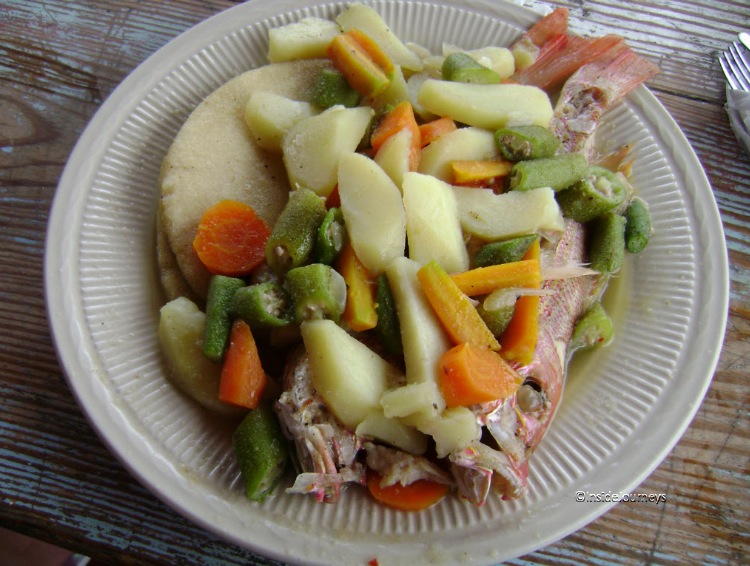
Once you place your order, for fish or seafood, and decide how you want it done – steamed, jerked, fried or grilled – it is prepared and brought to your table.
Steamed Fish with potato, carrots, okra, bammieJerk Lobster
I’ve had the steamed snapper and it is delicious. The jerked lobster is to die for but if you visit between April 1st and June 30th, you’ll be out of luck. It is illegal in Jamaica for anyone to have or serve lobsters, whole or in part — this is so that the lobsters can breed and replenish.
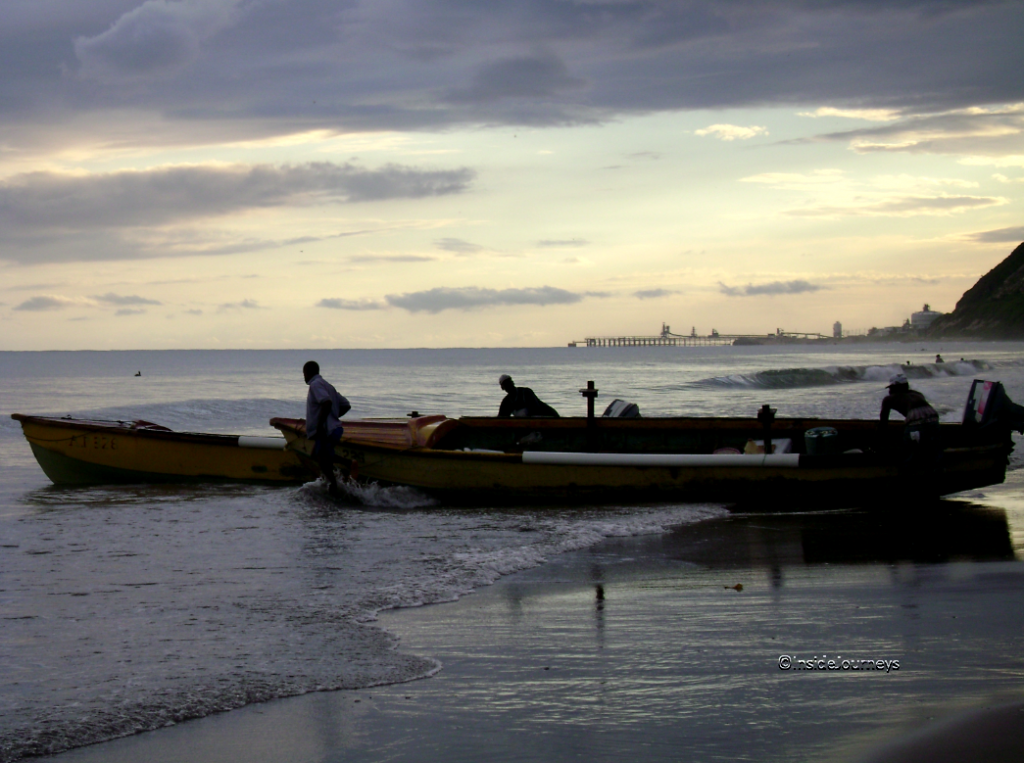
You can also select sides: roasted breadfruit, bammie or rice and peas. While you wait for your order, grab a cold Red Stripe, rum and Coke or any drink from their extensive selection, or watch the fishermen push off or return from fishing.
Pushing out to sea
Little Ochie is more than a restaurant, it’s an experience that delivers big taste without breaking the bank.
Little Ochie, 876-382-3375 or 876-610-6566
Like this post? Subscribe to read more, comment and share.
Until I purchased my apartment several years ago, home, for me, meant the place where I grew up in Jamaica; the place I go to relax and recharge when life in the U.S. takes its toll, the place where my heart really is.
Then, it became “home, home” to differentiate it from my “home” – the place I owned.
When I go “home, home” I revert to the person I was when I lived there, except now, I’m the adult. I have the freedom to do whatever, go where ever.
So I explore. I explore the place and I explore the me I am when I’m there. The me that feels free – to engage, to push back, to confront, to love, to be passionate, to be playful. It’s the me that sometimes comes to the fore when I’m in the States but takes so much more energy to be.
And simple things, like drinking the juice or water of a freshly picked coconut, make me smile.
Getting the coconutGetting it readyYou really have to know what you’re doingIt’s all in the wrist
Like this post? Subscribe to read more, comment and share.
It’s about time that New York is recognized as a major player in the movie making business. After all, we New Yorkers have to put up with actors and celebrities who call New York home and movie trailers that clog our streets so we can’t park our cars on about 30,000 location days every year.