Toronto: Revisiting a Favorite Haunt

Even though I’ve visited Toronto countless times, I always look forward to each new trip. So when I found out that this favorite haunt was in my work future, just the thought of traveling there made returning to the nine-to-five world attractive. I couldn’t wait to start so I could get on the plane.

In addition to seeing family and friends, I’d be staying downtown – something I hadn’t done since my days at university when I’d crash at my aunt’s and roam the city for hours. I had done that so often, I felt I knew that part of Toronto like the back of my hand.

Time has changed the entire downtown façade now and nothing is how I remember it but I was eager to see if I could find something that I recognized, something I could share with my aunt, who returned to live in the UK more than 20 years ago.

Toronto: Revisiting a Favorite Haunt
My suite at 1 King West

Unfortunately, the trip that I envisioned did not materialize. I’ll tell you why: the weather. The temperature went up and down about as often as the elevator in my hotel. When they started talking snow, I was ready to pack my bags for someplace warm. Believe me, I was not happy.

The bright spot during the trip was my hotel, 1 King West. Located in the heart of Toronto’s financial district, it is close to my office, the Eaton Center, the Bay and Yonge-Dundas Square. And from my suite on the 31st floor, I had an unobstructed panoramic view of the city.


I saw the sun as it broke the horizon in the mornings painting the sky streaks of red, then in the evenings as it slipped quietly away, giving space to millions of beads of streetlights and headlights to try to match its luminosity.

I spent the first few evenings just looking at the sunset. When I finally made it to the Eaton Center, Toronto’s largest mall, I was so overwhelmed by its 330 stores, I wanted everything and nothing. Nothing jumped out at me and I walked out without buying a pin.


Realizing the mood I was in, I gave up and followed the signs to the extensive food court on the lower level and let my nose take over. I settled for an Indian dish of chicken curry that actually sounded and had a better aroma than taste. But get this, they served it on real plates! I opted for real silverware too. Plastic is also available. Unfortunately, most of my meal went into the garbage. 

As I walked back to the hotel, I tried to remember Yonge Street as it was during my early visits. Except for the name, I could have been in any city anywhere. I should take some photos for Auntie, I thought. But where would I start?

Further Reading:

[simpleazon-image align=”none” asin=”1492971502″ locale=”us” height=”160″ src=”http://ecx.images-amazon.com/images/I/51Ol9fZp9eL._SL160_.jpg” width=”107″]

Linking up this week with Nancie’s Travel Photo Thursday at Budget Travelers Sandbox.


Cooking With My Mama

Hardly a day goes by that I don’t think of my mama, who I lost 13 years ago today. Mama baked almost every Christmas but she cooked only on special occasions so most of my experiences with her in the kitchen center around baking.

Those memories are so clear in my mind, they’d practically overshadowed her visits when she’d commandeer my kitchen and take over all the cooking. It never ceased to amaze me how the same woman who only cooked at home when the “spirit moved” her had the energy and enthusiasm of someone younger once she landed on my doorstep.

Mama would have a meal ready for us every evening except Friday when she’d use whatever was left over to make something new. On Sundays, she’d prepare dinner, as well as dessert.

It was during one of her visits that I asked her to show me how to make escoveitch fish. Although I was confident about preparing most of our staple foods, the thought of making escoveitch fish left me feeling a bit incompetent. Mama was surprised that I didn’t know but eagerly agreed to show me.

That weekend, we bought red snapper and as soon as we returned, Mama set to work preparing it. Mama was nothing but thorough and even though they had cleaned the fish at the market, it wasn’t up to her standards. She found scales they had missed and trimmed any fins that weren’t properly cut. Then she washed the fish thoroughly in water mixed with limes.

Next, she patted them dry with paper towels and set the fish aside on more paper towels to absorb any remaining water. Since we would be frying the fish, she wanted to make sure there was very little moisture left. (You can also coat the fish lightly with flour to avoid having the oil pop.)

Once that was done, Mama measured and mixed salt and freshly ground black pepper. She scored the fish on both sides and rubbed in the salt and pepper mixture. She also rubbed the mixture on the inside of each fish then set them aside to marinate.

While she waited, Mama cut up onions and Scotch bonnet peppers. She also Julienned some carrots and set that aside too.

After she fried the fish, Mama put them in a Pyrex dish. She poured vinegar into another saucepan, added onion and Scotch bonnet slices and pimento berries and let them simmer for a few minutes.

The pungent aroma of vinegar, onions and Scotch bonnet can be an assault on the senses so it’s best to open a window or turn on a fan.

Once the onion had wilted, Mama turned the flame off and poured the vinegar mixture over the fish and let it marinate overnight. Leaving it in the marinade overnight allows the fish to absorb the flavors of the vinegar and pepper.

Mama’s Escoveitch Would be a Hit for Easter

Thousands of pounds of escoveitch and fried fish were eaten in Jamaica between Good Friday and yesterday, Easter Monday.  Easter is just not Easter without it or the ubiquitous bun and cheese.


Have a foodie post you’d like to share? Join the #FoodieTuesday linkup and add it here  –

  • Add the link to your foodie post in the link tool below.
  • As a courtesy, please include a link back to this post.
  • To make it a fun linkup, don’t forget to leave a comment here and comment on as many posts as you can.
  • If you Tweet, G+, Facebook please use the hashtag #FoodieTuesday.


[inlinkz_linkup id=396974 mode=1]

Jamaica: Gratto Bread

Jamaicans love bread, it’s a staple of our diet, and we have several types. Our hardo bread (hard dough) goes with everything from condensed milk to bully beef, and creamy Anchor butter. The soft, buttery coco bread seems even tastier when it’s enveloping a hot and highly spiced patty.

Peg bread does well with a mug of tea; duck bread is a must at Christmas time, and bammy (cassava bread) and gratto bread aren’t complete unless they’re accompanied by fried fish – especially sprat with the gratto.

When my aunt visited us a few Christmases ago, she brought a list of the foods she had to have while she was home. It included otaheiti apples, gratto bread and fried sprat.

Jamaica: Gratto Bread
Freshly baked gratto bread

I hadn’t seen gratto bread in many years and when my aunt mentioned it, I thought immediately of my childhood and my grandmother who would buy gratto from a bread van that passed by her house with breads and other freshly baked goods a few times a week. But I wasn’t sure where I’d find gratto so I checked with my neighbor.

You’ll have to go to a bakery (rather than the supermarket), she said. It took us a few days and a few bakeries before we found one that sold gratto bread. (One of my aunt’s friends brought her otaheiti apples from her garden but we didn’t find sprat until the evening before we drove her to her next destination.)

What’s Gratto Bread?

The word gratto (sometimes gatto), according to the Dictionary of Jamaican English (Cassidy and LePage), is from the French, gateau. I haven’t been able to find out more about the French connection or the origins of this bread, which the dictionary says “is rolled out flat, folded over, then folded again to produce four layers which are then boiled (or usually) baked.” It seems only a few bakeries still make it.

When the gratto finally arrived, it didn’t look familiar and no matter how much I searched my brain, I couldn’t retrieve an image of the one my grandmother used to buy. This was square, the size and shape of a small sheet cake. There were holes on the edges and in the center, likely to vent it while it baked.

It didn’t look familiar to my aunt either. The gratto bread she remembers had a cornmeal filling. Goes to show that even on an island the size of Jamaica, foods can vary between regions. Despite not recognizing the gratto bread, my aunt was so excited to try it, I barely had time to take a photo before she cut a piece off.

It tasted slightly sweet but the texture was similar to the dense, hardo bread that we normally eat. Although it didn’t have the cornmeal filling that she remembered and she didn’t fried sprat to go with it, my aunt enjoyed her gratto bread and I felt very happy that she was able to cross that off her list.

How to join the #FoodieTuesday linkup –

  • Add the link to your foodie post in the link tool at the bottom of this post
  • Leave a comment.
  • As a courtesy, please include a link back to this post.
  • Tweet, G+, Like, etc., using the hashtag #FoodieTuesday.

 [inlinkz_linkup id=394745 mode=1]

African Burial Ground National Monument, NYC

Before the American Revolution, New York had more enslaved Africans – its most valuable commodity – than any other colony in the North. There were also free Africans, some descended from those freed by the Dutch West India Company. Men cleared farmland, filled swamps, and built structures and roads like Broadway and The Wall (today’s Wall Street). Women sewed, cooked, harvested, and cared for owners’ children as well as their own. From an early age, children carried water and firewood. The work was hard and death rates for Africans were disproportionately high. – National Park Service / US Department of the Interior

Between 1690-1794, approximately 15,000 enslaved and free Africans were buried in a 6.6-acre plot in Lower Manhattan near what is now Duane and Elk Streets. The area was identified on maps of the time as the Negros Burial Ground.

In 1991, an archeological team that was field-testing a construction site in Lower Manhattan (a requirement on any project which uses public funds that may have the potential to impact historic resources) made a surprising discovery – skeletal remains 24 feet below ground.

They stopped excavation when it was determined that the remains were from the Negros Burial Ground. In all 419 bodies of men, women and children were unearthed. Bone fragments and other items uncovered at the site were sent to Howard University for examination.

The remains held a compelling narrative about the life of New York City’s African population.  It showed that many were malnourished, suffered from delayed bone development and recurrent illnesses. Nine percent of those buried at the site were children 2 years of age and younger.

Many of the dead were adorned with beads, which were culturally significant, and shells that were believed to “enclose the soul’s immortal presence.” Some had their eyes covered with coins.

At first, the government wanted to exhume and preserve the remains and continue construction of the 34-story Ted Weiss federal building but the community was outraged. Months of protests led to an agreement. A third of an acre of the site was set aside for a memorial.

In 1993, the African Burial Ground was designated a National Historic Landmark, and a National Monument in 2006. In 2003, the remains were reinterred in seven raised mounds at the site.

A memorial, which was designed by Rodney Léon was completed in 2007.  It features a sunken Libation Court, a gathering space for cultural ceremonies, and is surrounded by a Circle of the Diaspora that is inscribed with signs, symbols, and images from the African Diaspora.

There’s also an Ancestral Chamber that provides sacred space for contemplation, and a Wall of Remembrance that describes events that contributed to the creation of the African Burial Ground. The location where the remains were reburied are marked by Ancestral Pillars.

African Burial Ground
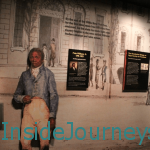
Exhibit at the Visitor Center

A visitor center, which is located on the ground floor of the Weiss Building, features a permanent exhibition which tells the story of the lives of Africans in New York through photos, scrapbooks and installations. Life-size and lifelike sculptures of men and women gathered around a coffin is the centerpiece of the exhibition.

African Burial Ground National Memorial Particulars

The African Burial Ground Memorial site, which is at the corner of Duane and Elk Streets, is closed during the winter. However, the African Burial Ground Visitor Center, located around at 290 Broadway at Duane Street is open Tuesday-Saturday 10:00 a.m. to 4:00 p.m. Admission is free, but donations are accepted.

Further Reading:
Gotham: A History of New York City to 1898 [simpleazon-image align=”center” asin=”0195140494″ locale=”us” height=”160″ src=”http://ecx.images-amazon.com/images/I/51A0v0-vafL._SL160_.jpg” width=”108″]

Linking up this week with Nancie’s Travel Photo Thursday at Budget Travelers Sandbox.

Negril’s Rick’s Cafe Turns 40 Years, Folks!

I was rushing towards Times Square around 5:20 p.m. a few weeks ago when I noticed the unmistakable colors of the Jamaican flag high atop one of the buildings in the heart of the square.

I slowed my pace and looked. Sure enough, it was the flag. It was emblazoned on the finely chiseled body of a man, his arms outstretched as he prepared to take a dive, his movements magnified frame by slow motion frame. I was still fixated on his body when I it registered: the Rick’s Café logo.

Before I knew it, before I remembered that I had my digital camera in my bag, the ad was gone, replaced by another not so memorable one. Darn!

I did the next best thing: I took out my phone and sent a text to everyone in my address book. “Rick’s Café is 40, they have an ad in Times Square!!”

Yes, folks, Rick’s Café, voted the Best Beach Bar by the Travel Channel, is 40 years old. Forty? I was surprised. When did that happen? Wasn’t it just the other day? Time sure flies, I thought.

I still remember the first time I heard about it. I was in a taxi on my way to JFK to catch an Air Jamaica flight home. The driver asked where I was going and when I told him, he asked if I’d ever been to Rick’s Cafe. I hadn’t, even though it’s located in Westmoreland, close to where I was headed.

Rick’s Cafe was founded in April 1974 when Negril, then mostly a fishing village with few amenities hadn’t even started dreaming of tourism – at least, not on the scale it is now.

I can’t remember the first time I visited but after that, it became a regular place to hang out and watch the sunset, a place to take friends who were visiting. Seriously, if you’re in to watching the sun as it slowly paints everything in its path orange, purple, red, gold, blues as it moves behind the horizon, drink in hand, then Rick’s Cafe is the place for you. (That finely chiseled body, I mentioned earlier, yeah, Rick’s known for that too. They’re usually several more like him and they’re like the icing on the cake.)

Rick's Cafe Turns 40 Years, Folks!
Rick’s Cafe ad, Times Square

The next day, I told all my Jamaicans friends at work to go check out the ad and I looked for it every day after that, camera and phone at the ready, but I didn’t see it. I was disappointed. Did I imagine it?

I returned for several more days, no luck. Honestly, I kinda gave up. Then one morning, as I was passing through at 8:30, which is late for me, I glanced up halfheartedly, and caught the last frame of the ad. Big smile brightened my face. Okay, I though, it’s still playing. And it seems to rotate on the hour at the half hour.

But just to be sure, I made a plan: I’d pass through Times Square at 5:30 to see if I’d catch it. Sure enough, I did. I left work late, the following evening not even thinking about the ad and saw it again. This time, it was at 6:30.

A few days later, I ran into Paul, one of the people I had told about the ad, in Times Square. He was in the right place – at the corner of 43rd Street and Broadway — but he was looking away from the ad.

I set him straight and we waited together. Several ads cycled through then without fanfare, the Rick’s Café ad appeared. Paul was still holding his cell phone staring at the ad instead of taking a photo – it happened to me too. I shouted at him, “Paul, tek di picture!”

That night, I sent out an email to my friends. We were going to Hell’s Kitchen for dinner the following evening. Let’s meet in Times Square, I said, so we can catch the ad together. Despite the rain, I hustled to the spot we had agreed on but they didn’t make it. Their loss, but I’ll try again. (Seeing it is such a joy, it’s like watching Usain (Bolt) or any of our athletes win. It fills me with tremendous pride, a pride we all share. It’s a Jamaican thing, an island thing. You understand?)

I have no idea how long the Rick’s Cafe ad is running but if you’re ever in Times Square and would like to see it, head for 43rd and Broadway. If you stand at the northeast corner and look up at the billboard above Europa, you’ll see it. It seems to run every hour on the half hour. At least that’s when I’ve seen it.

Happy Birthday, Rick’s Café! You’re aging gracefully and still managing to maintain your wild side. Here’s to another 40 years of providing us the best vantage point to enjoy the most spectacular sunsets in Negril.

Rick’s Cafe is located on West End Road in Negril, Jamaica. 876-957-0380

Yummy Yellow Yam

Traveling through Jamaica’s rural areas is something I look forward with as much anticipation and excitement as a child waiting for a birthday or Christmas. It’s always a treat because I never know what I’ll see.

Several months ago, I was driving with three of my neighbors from Clarendon on the south central coast back to Montego Bay on the north west coast. Our trip took us through parts of Trelawny, St. Ann and Manchester – all well-known for different types of produce.

This particular Friday afternoon was bathed in the warm, golden glow of the setting sun as, at almost every turn, we saw farmers bringing their produce on donkeys and in small carts from the fields to the side of the road. Pickup trucks would take it the rest of the way to market.

Yummy Yellow Yam
Bringing yams from the field

There were mounds of yellow yams, mostly. But there were also otaheiti apples, Scotch Bonnet peppers, scallion, and thyme.

Most times we’d slow down just long enough for someone to stick their head out the window and ask, “How much a pound is the yellow yam?” or “Do you have any sweet peppers?”

Usually, price dictated whether we’d stop but when we saw this man with his son, something about him made us decide to buy. As soon as we found a good spot to park, all four of us jumped out of the car and ran across the road to choose a piece of yellow yam.

Yummy Yellow Yam
Yams for the market

They were weighing and sorting the freshly dug yam, the soil stubbornly clinging to each piece. They looked so delicious, it was difficult to know which to choose. So we let him decide.

Jamaica grows about eighteen varieties of yams, including yellow yam, St. Vincent, white, Lucy, and Negro. Yellow yam is by far the most popular. Trelawny, the parish we were in when we stopped to buy, accounts for up to 60% of the yams grown in Jamaica and almost half of what is exported — mostly to supply the growing demand in West Indian communities in the UK, US and Canada. (I was surprised to discover that Amazon sells yellow yam. [simpleazon-link asin=”B00I12V9IQ” locale=”us”]Roundleaf Yellow Yam imported from Jamaica (5 lb)[/simpleazon-link])

Yam adds potassium, protein, vitamins and folic acid to the diet and because it is packed with soluble fiber, it is suitable even for young children. Yams are also great for people with diabetes as it slows down the release of sugar into the cells.

Yams are denser in texture than the potato and can be eaten boiled (and mashed with butter, my favorite) or roasted. One of the things I look forward to on road trips is buying roasted yellow yam and saltfish from roadside vendors.

Most Jamaicans love yellow yam and have it at breakfast, lunch and dinner. It is even the title of a popular folk song, When wi roas di yellow yam. Take a listen here.

When Olympic champion, Usain Bolt, won gold in the 2008 Olympics in Beijing, his father was reported as saying his speed was due to his diet, specifically the yellow yam. Not surprising as Bolt is from yam country, Trelawny.

How to join the #FoodieTuesday linkup –

  • Add the link to your foodie post in the link tool at the bottom of this post
  • Leave a comment.
  • As a courtesy, please include a link back to this post.
  • Tweet, G+, Like, etc., using the hashtag #FoodieTuesday


[inlinkz_linkup id=392365 mode=1]


The World Trade Center Building

Walking south from the Staples store on Broadway, I looked west down Vesey Street and saw the World Trade Center as if for the first time. With its solid-looking base tapering into a 400’ antenna, it looks as if it’s reaching to the sky.

World Trade Center building
Seen from Vesey and Broadway Streets

I stopped and stared for a few minutes before taking out my camera. I’ve taken other photos of the World Trade Center before from near the site and from the New Jersey side but I think this is probably one of the best views I’ve seen. 

At 1,776 feet (the year the United States Declaration of Independence was signed), it is, at the moment, the tallest building in the U.S., and the fourth tallest in the world.  And it does looks pretty attractive.  Framed by surrounding buildings, softened a bit by a few leafless trees, it’s shiny, ultra modern exterior and clean lines makes me think of the narrow legged pants that seem to be the rage in men’s fashions.

World Trade Center Antenna
The antenna at the World Trade Center Building

As I looked at it through the viewfinder, my camera lens bringing it closer, I could almost understand why a teenager from New Jersey took an elevator to the antenna a few weeks ago.

And I could almost imagine daredevil climbers pouring over every photo taken from every angle trying to figure out how to scale it.

I was about to move on when I noticed something else: a small plane flying away from the building.  Once again, I stopped and quickly refocused so I could capture it.

WTC Plane
Can you see that small plane?

I’ve yet to visit the museum. Truth be told, I’m a little nervous. Too many memories.

Linking up this week with Nancie’s Travel Photo Thursday at Budget Travelers Sandbox and Noel’s Travel Photo Monday at Travel Photo Discovery. Be sure to head over to view more photos from around the world.

Expedia Brings Concierge Service to Montego Bay

I don’t remember using Expedia, the online booking agency, to buy airline tickets though I’ve used it to compare prices. This time they had the best price on a nonstop ticket to Montego Bay. That clinched it.

A few days after I’d completed my purchase, I received an email from Expedia introducing my personal Jamaica concierge. Although I didn’t need the complimentary concierge service, which is provided by an Expedia Local Expert®, I was intrigued.

Expedia Concierge ServiceWhen I called the toll-free number in the email, Dania, Expedia’s Concierge’s distinctive Jamaican voice greeted me. Dania explained that she could assist me to book a transfer to my hotel and pre-book any activities I was interested in but since I didn’t need her expertise, I chatted with her instead.

Expedia, she explained, had partnered with Jamaica Tours, a local company, to launch the service, which started last August. According to its website, Expedia Concierge Service is provided by “knowledgeable” local experts in several locations including Hawaii, Mexico, and Las Vegas, Orlando and New York.

Jamaica Tours Limited, a 50 year old company, is the island’s largest ground tour operator and destination management company.

Although I didn’t need Expedia’s Concierge Service this time, I’m happy to learn that they offers it. There’s a lot of information about local attractions online, for example, but when you’re traveling to an unfamiliar destination, it’s helpful and reassuring to have someone who knows the scene help you find what you need so you can hit the ground running when you arrive.

Have you used a concierge service during your travels?

Jackass Corn

I heard about jackass corn when I was younger but I don’t remember seeing let alone trying it. Lacking any context, I imagined it was a variety of corn – one that jackasses liked to eat. I know that’s pretty literal but what else could I think?

I hadn’t thought of or heard about jackass corn until sometime last year when my friend, Sandra, and I walked into 14 Parish Restaurant, a small take out spot in Hackensack, NJ. The typical assortment of sweets  – rock buns, gizzadas, grater cakes – sat on display in a glass case on the counter but there was one item I didn’t recognize. Curious, I asked what it was.

Jackass Corn
J

I chided the young cashier for not knowing and he went back to the kitchen to ask.

“It’s jackass corn,” he said when he returned, his face still wearing a puzzled look.

Jackass (or donkey) corn is a hard biscuit made of flour, water, coconut milk, and nutmeg. It is rolled flat, cut into rectangles and baked. According to the Dictionary of Jamaican English, it’s called jackass corn because when you eat it, it sounds like the sound a donkey makes when it’s eating corn.

Jackass Corn


Write a review

Print

Ingredients
  1. 1 cup all-purpose flour
  2. 1/4 teaspoon baking powder
  3. 1 cup sugar
  4. 1/2 teaspoon ground nutmeg
  5. 1/4 teaspoon salt
  6. 1 cup shredded unsweetened coconut
  7. 3 tablespoons water
Instructions
  1. Preheat the oven to 375F. In a medium-size bowl, combine the flour, baking soda, sugar, nutmeg and salt. Stir in the coconut. Add the water and mix, forming a very stiff dough that will not crumble.
  2. Roll out the dough on a floured board to 1/8-inch thickness. Cut the dough into small rectangles. Place the pieces onto a greased cookie sheet and prick each one with a fork. Bake for 8 to 9 minutes, or until brown. Remove from the oven and transfer to a plate to cool.
Adapted from Lucinda's Authentic Jamaican Kitchen
InsideJourneys https://insidejourneys.com/

Jackass corn used to be a popular snack enjoyed by school children as well as adults. It fell out of favor perhaps because it’s likely seen as irrelevant, or unsophisticated next to prepared snacks like potato chips and Cheese Trix.

But one of the unforeseen and unintended impacts of migration is that Jamaicans, like other immigrant communities, cling to the traditions that keep them connected to home. One of the many food items they hold on to is jackass corn, which explains why it would be available for sale in a small restaurant in New Jersey.

As I expected, the owner said he sells mostly to people of a certain age. Since I’d never tried them, I handed over $2 for two biscuits which came wrapped tightly in plastic. My aunt couldn’t believe it when I told her what I had found.

I couldn’t bring myself to eat my treat right away and kept the jackass corn for almost a week before finally ripping off the plastic. I tried the first one.  It was slightly sweet, with a hint of nutmeg, crisp but not as hard as I expected. I made a cup of tea, fresh mint, and had the second one. You can also have jackass corn on its own as a snack.

How to join the #FoodieTuesday linkup –

  • Add the link to your foodie post in the link tool at the bottom of this post
  • Leave a comment.
  • As a courtesy, please include a link back to this post.
  • Tweet, G+, Like, etc., using the hashtag #FoodieTuesday

For more recipes, check out Lucinda Scala Quinn’s cookbook, Lucinda’s Authentic Jamaican Kitchen

[simpleazon-image align=”none” asin=”0471749354″ locale=”us” height=”110″ src=”http://ecx.images-amazon.com/images/I/51vTukacb2L._SL110_.jpg” width=”98″]

[inlinkz_linkup id=389570 mode=1]

Knutsford Express Went Above and Beyond For Me

I was exhausted when I got home. We had spent a long and exhilarating day driving more than 200 miles to visit heritage sites in St. Catherine, Jamaica and all I could think of was crawling into bed and getting some sleep.

I was about to turn off the lights when I remembered that I still hadn’t booked my ticket on the Knutsford Express for my trip to Falmouth the next morning. I logged on quickly and was thrilled to see that a bus was leaving Montego Bay at 7:30 a.m. I could sleep a little longer, I thought, as I completed the purchase.

I was ready before my 7:15 pickup but as I closed the gate to my house, I panicked. The bus was leaving at 7:30, I should be at the station at 7:15. I called Eton, my taxi driver.

I’ll be right there, he said. I’m only a few minutes away.

Eton drove like a bat out of hell, collapsing the trip to less than 10 minutes. Thankfully, of seven traffic lights only one was red.

Knutsford Express
Andre Johnson

Walking up to the Knutsford Express counter at 7:25, I told the agent that I had a ticket for the 7:30 bus to Falmouth.

“There isn’t a 7:30 bus to Falmouth,” she said. “The bus left at 7:00 a.m. and there isn’t another one till 9.”

“But I have a ticket,” I protested.

She peered at her computer screen and said to no one in particular, “The computer messed up,” picked up a phone and walked away from the counter.

On any other day, the 9:00 would have been fine. But this was the first day of a three-day historic preservation seminar I helped Falmouth Heritage Renewal to organize. I couldn’t afford to be late.

I pulled out my phone and punched in Eton’s number.

“Yes, Miss,” he said.

By the time I put my phone back in my bag, the agent returned.

“The Negril driver will take you to Falmouth,” she said.

I was stunned. The least I expected was that they’d give me a complimentary ticket but to take me to Falmouth? Wow, that was going above and beyond.

Before I could cancel my taxi, a tall young man with an engaging smile approached.

“Are you the person going to Falmouth?”

He led the way to his bus, a regular 40- or 50-seater. I couldn’t believe my luck. Actually, this was more than luck. This was a gift straight from the gods. How else to explain a bus that materialized right when I needed it?

I took one of the seats directly behind the driver’s and we pulled out of the station.

The first thing I asked was his name. Andre Johnson. Laughing, he added that both his names are common in Jamaica.

I told Andre my story and thanked him for agreeing to drive me to Falmouth. He said he had just come in from Negril and was about to leave when Keisha, the agent I spoke with, told him what happened. I felt even more grateful. The timing was pure serendipity.

I’ve been taking Knutsford Express to Kingston for at least five years and have always been impressed by their reliable and on-time service, friendly and efficient staff, comfortable and clean buses, even the chilled complimentary bottle of water they provide each passenger.

Now, thanks to Andre and Keisha, Knutsford’s stock has increased several fold in my book.

Andre, a 28 year old (he was impressed when I guess his age correctly) father of an adorable little girl and another child on the way, told me he’s been working with Knutsford Express for about nine months. Prior to joining the Knutsford team, he had also worked as a mechanic for a transport company.

Many of the Knutsford’s drivers, he added, are experienced auto mechanics so they know when something is wrong and can tell the company’s mechanics exactly what and where the problem is. Hearing that made me feel more confident in the company.

As we pulled into Falmouth, I asked Andre if I could take his photo for a post I planned to write about my Knutsford experience. He adjusted his tie and struck a pose.

I was smiling all day as I told almost everyone I met about my experience. Everyone was surprised at my good luck.

The next day, as I waited for my return trip to MoBay, I shared my story with Alexia, the Knutsford Express agent in Falmouth. She didn’t seem surprised by how Keisha had handled the situation, adding, “the error was ours.”

Fantastic, I though, Knutsford’s agents have the latitude to problem solve.

A lot of us, especially those Jamaicans who’ve lived elsewhere, are quick to bemoan the service we receive from many of the island’s companies. I can’t disagree: the majority of employees could use customer service training and be empowered to resolve issues as they arise.

And many local companies need to realize that bad service drives customers away. Clearly, Knutsford Express understands this and provides consistent, first-rate service. (The other company, in my experience, that also gets it is Flow.)

So I’m taking this opportunity to ‘big up’ Knutsford Express, Andre Johnson, Keisha, Alexia and the entire team for the service they provide. They really do take you from city to city in comfort and style.